


The Romantic Road, Germany’s only certified quality vacation route, offers art and culture enthusiasts a variety of museum experiences that can be combined with an attractive short stay. Along the route from Würzburg to Füssen, there are both large and smaller, charming museum treasures to discover, and their current exhibition themes make it possible to take a journey through time. The museums’ themes offer a wide range of options for all travelers, turning every trip to the Romantic Road into a journey through history, cultures, and the ages.
Translated with DeepL.com (free version)
Take a Climate Journey Through Time at the Museum of Franconia
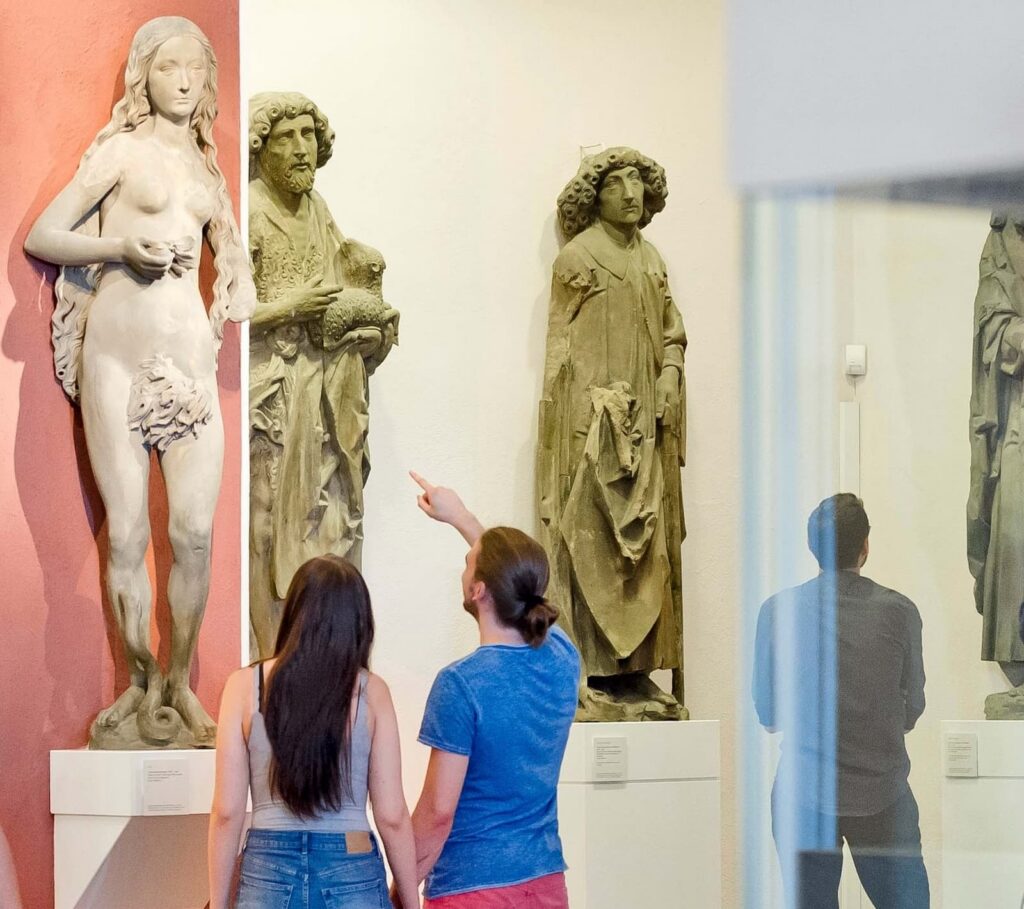
The Museum of Franconia is located in Würzburg, within the Marienberg Fortress. The exhibits in its significant collections serve as historical records and sources of information on the art and cultural history of Franconia. They include arts and crafts, paintings, furniture, Judaica, faience, as well as coins and medals. Through November 15, 2026, the Museum of Franconia is presenting a new special exhibition with the ambiguous title „Geht Grad° so? Klima in Unterfranken“ (“Is That How It Goes? Climate in Lower Franconia”). It poses the question: Can we gain new perspectives on how to address current global warming by examining humanity’s relationship with the climate in the past? Here, visitors learn how humanity’s relationship with its environment has changed from the last Ice Age through the beginnings of agriculture to the present day, and how—especially since the Industrial Revolution—humans have increasingly influenced the climate. As you walk through the exhibition, you’ll encounter objects from prehistory and the present day. They invite you to discover connections between life today and prehistory. What do Adam and Eve, the “lying stones,” and a barrel rider on a small wine barrel have in common? They tell us something about humanity’s relationship with its environment. And they illustrate how climate change and human influence have shaped our landscape, our history, and our art and culture throughout the centuries. Eight interactive stations in the permanent exhibition at the Museum of Franconia invite visitors on a varied journey through the ages.
Crafted with attention to detail
The Käthe Kruse Doll Museum in Donauwörth features a permanent exhibition of over 150 dolls, mannequins, and dollhouse dolls from the world-renowned Käthe Kruse doll factory, spanning from its beginnings around 1910 to the present day. The museum is dedicated to the life’s work of Käthe Kruse, who achieved worldwide fame with her natural, child-like dolls. In 1910, Käthe Kruse presented her handmade dolls for the first time in the exhibition “Toys Made by Hand” at the Tietz department store in Berlin. The dolls caused quite a sensation, and Käthe Kruse became famous virtually overnight. After World War II, the Käthe Kruse workshops were relocated from Bad Kösen to Donauwörth, where dolls are still produced today in the tradition of Käthe Kruse.
With Humility to the Füssen Dance of Death
And in Füssen, the Füssen City Museum offers visitors a special cultural treasure. In the south wing of the former St. Mang Monastery, exhibits on the history of St. Mang Monastery, the Baroque rooms—including the banquet hall, library, and chapter house—the St. Anna Chapel with the Füssen Dance of Death, lutes and violins, a miller’s room, the town’s history, and the cloister are on display, comprehensively presenting the impressive history of the town of Füssen. Four hundred years ago, Abbot Matthias Schober commissioned Jakob Hiebeler to paint a Dance of Death for St. Anna’s Chapel. At that time, the chapel served as the burial place for the abbots and the nobility of the surrounding region. The Füssen Dance of Death is the oldest surviving Dance of Death in Bavaria and is today considered one of the most significant of its kind in all of Europe. Under the motto “Say Yes, Say No, But the Dance Must Go On,” twenty social classes—led by the Pope and the Emperor—follow Death in the Füssen Dance of Death. The motif of the dance expresses the ambivalence between life and death, thus illustrating the delicate balance of life.


