


The Romantic Road, Germany’s only certified quality tourist route, offers a wealth of beautiful parks and gardens in early summer that amaze visitors with their stunning blooms, diverse flora, and peaceful retreats. The design elements in the form of exclusive garden architecture, and not least the opportunity to relax in a café or restaurant surrounded by nature, make excursions to the parks and gardens along the Romantic Road—from Würzburg to Füssen—an unforgettable experience in nature. Weikersheim, Donauwörth, and Rain am Lech are excellent examples of a diverse garden culture.
In the Baroque palace gardens of Weikersheim, for example, symmetry and rich diversity—the typical characteristics of a Baroque pleasure garden—complement one another. Boxwood hedges frame colorful flowerbeds, potted plants and sandstone figures add distinctive accents, and tree-lined avenues create visual axes and provide welcome shade. The crowning glory of the Weikersheim gardens is the orangery. The gardens of Weikersheim Palace are also particularly famous for their many original 18th-century figures. The sandstone sculptures allude to the pantheon and mythology of Greek and Roman antiquity. Like all Baroque rulers, Count Carl Ludwig von Hohenlohe-Weikersheim compared himself to the gods and heroes of antiquity. An unusual contrast to this are the famous gnomes of the palace gardens, which depict various craftsmen and palace servants. After the visit, one can’t help but wonder: Was I just in the famous gardens of Versailles or in the palace gardens of Weikersheim?
At the so-called “Umkehr” in Donauwörth—the confluence of the Danube and the Wörnitz—there is a small but charming park that invites visitors to linger by the water. Gebhardtplatz features numerous benches and lovingly landscaped flower beds. It is also home to the Peace Linden Tree and the Peace Dove of the Jerusalem Way, the world’s longest pilgrimage and peace trail. From the park at the tip of the Danube, the river begins its journey out of town, passing the old Danube harbor, which stands at a historic site commemorating the starting and ending points of Danube river travel in days gone by. The park exudes a special sense of tranquility; the gentle ripples where the rivers meet allow your thoughts to settle.
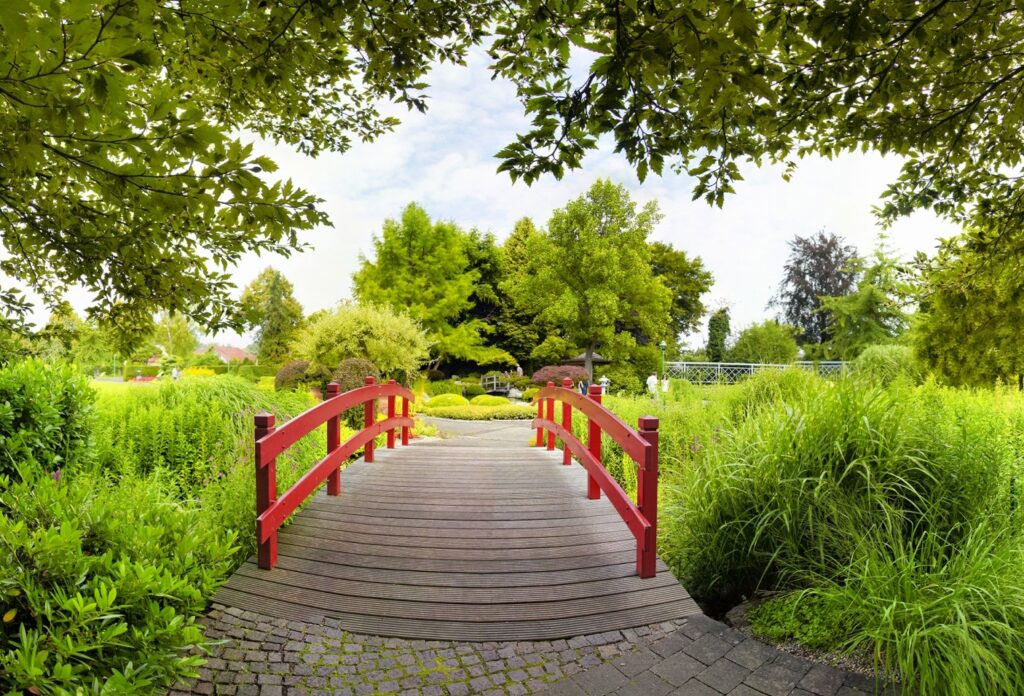
Relax in a peaceful park setting, find inspiration while strolling through the show garden, admire the wide selection of plants and gardening supplies, and treat yourself to a meal in the restaurant with a view of a beautiful garden: all this awaits visitors at the Dehner Blumenpark in Rain am Lech. Spanning 30,000 square meters, guests will find Asian, Mediterranean, and English garden elements, a large Japanese garden with ponds, water steps, and large bonsai trees, and magnificent, seasonally planted ornamental beds that will delight every plant lover. In the adjacent 12,000-square-meter nature education garden, visitors are introduced to the beauty of local flora and fauna. But there is another garden gem to admire in Rain am Lech: In the ducal castle in the northeast corner of the town, a late-Gothic building complete with gardens from the 15th century awaits discovery. Duke Stefan II of Wittelsbach began its construction, and his son, Duke Ludwig the Bearded of Bavaria-Ingolstadt, completed it after 1421. The castle garden entices visitors with a romantic atmosphere of flowers and stylishly laid-out beds, which blend beautifully with the historic walls thanks to their coordinated color accents.
“A garden is a wonderful link between the past and the future, a place where memories grow and dreams flourish,” says a proverb by an unknown poet. From the Hofgarten at the Würzburg Residence to the Botanical Garden in Augsburg and the Wallerstein Gardens, the Romantic Road offers the perfect setting for magical garden tours that will remain in your memory forever.


